Wheels and castors for food processing industries
Close
'%3e%3cg id='Final-Copy-2_2_' transform='translate(1275.000000, 200.000000)'%3e%3cpath class='st0' d='M7.4,12.8h6.8l3.1-11.6H7.4C4.2,1.2,1.6,3.8,1.6,7S4.2,12.8,7.4,12.8z'/%3e%3c/g%3e%3c/g%3e%3c/g%3e%3cg id='final---dec.11-2020'%3e%3cg id='_x30_208-our-toggle' transform='translate(-1275.000000, -200.000000)'%3e%3cg id='Final-Copy-2' transform='translate(1275.000000, 200.000000)'%3e%3cpath class='st1' d='M22.6,0H7.4c-3.9,0-7,3.1-7,7s3.1,7,7,7h15.2c3.9,0,7-3.1,7-7S26.4,0,22.6,0z M1.6,7c0-3.2,2.6-5.8,5.8-5.8 h9.9l-3.1,11.6H7.4C4.2,12.8,1.6,10.2,1.6,7z'/%3e%3cpath id='x' class='st2' d='M24.6,4c0.2,0.2,0.2,0.6,0,0.8l0,0L22.5,7l2.2,2.2c0.2,0.2,0.2,0.6,0,0.8c-0.2,0.2-0.6,0.2-0.8,0 l0,0l-2.2-2.2L19.5,10c-0.2,0.2-0.6,0.2-0.8,0c-0.2-0.2-0.2-0.6,0-0.8l0,0L20.8,7l-2.2-2.2c-0.2-0.2-0.2-0.6,0-0.8 c0.2-0.2,0.6-0.2,0.8,0l0,0l2.2,2.2L23.8,4C24,3.8,24.4,3.8,24.6,4z'/%3e%3cpath id='y' class='st3' d='M12.7,4.1c0.2,0.2,0.3,0.6,0.1,0.8l0,0L8.6,9.8C8.5,9.9,8.4,10,8.3,10c-0.2,0.1-0.5,0.1-0.7-0.1l0,0 L5.4,7.7c-0.2-0.2-0.2-0.6,0-0.8c0.2-0.2,0.6-0.2,0.8,0l0,0L8,8.6l3.8-4.5C12,3.9,12.4,3.9,12.7,4.1z'/%3e%3c/g%3e%3c/g%3e%3c/g%3e%3c/g%3e%3c/svg%3e) Le tue preferenze relative alla privacy
Le tue preferenze relative alla privacy

Wheels and castors for food processing industries
Wheels, castors and accessories for trolleys used in internal industrial logistics
Castors for scaffoldings
Rollers, drive wheels and stabilizer wheels for pallet trucks
Compact castors for AGVs, AMRs and robotic systems
 TECHNICAL DATA
Jun 1, 2023
Reading time: minutes
Vibrations can be an issue when there is a need to move loads for production or logistical needs.
Industrial plants and mechanical workshops, often feature uneven floors with obstacles, grout lines, steps or cracks; or are simply old and damaged, characterised by holes and grooves.
It should be mentioned that flooring can be made of different materials, which sometimes can be fragile as well as extremely delicate.
In these situations, particular attention should be paid to how loads are moved when choosing the industrial wheels to be fitted to trolleys or machinery used for handling operations.
One of the most delicate aspects relates to the fact that the vibrations of the trolley, in some cases, can damage, as well as tip over, the transported load especially when it is particularly delicate.
In addition to the assessment of the load capacity, it is therefore essential to identify the most appropriate covering.
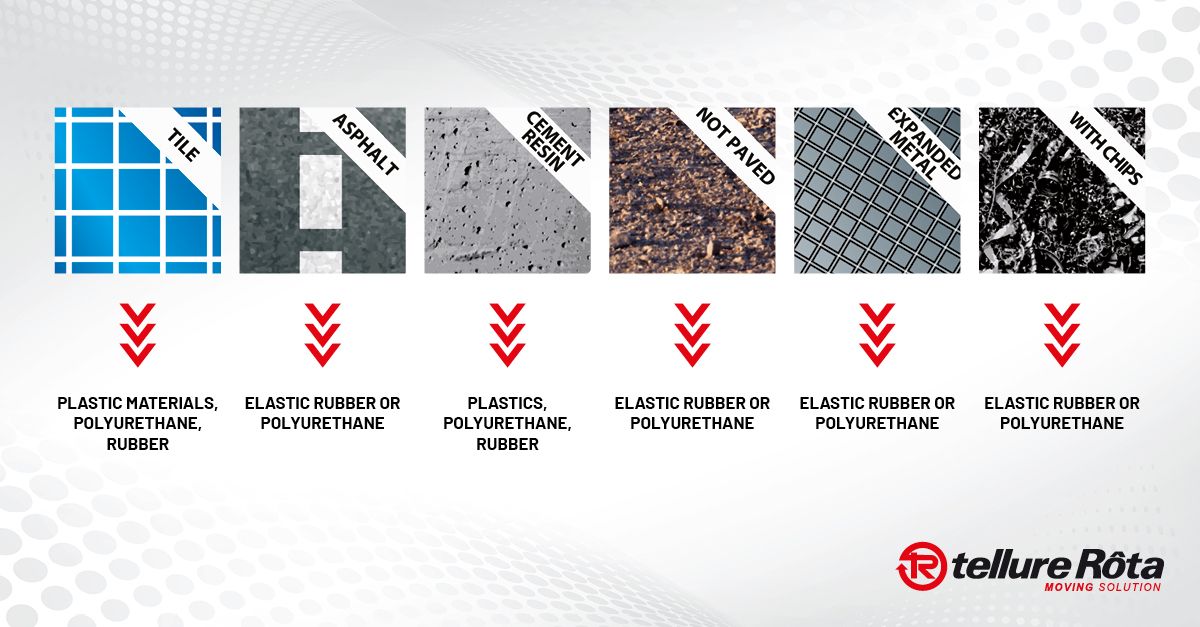
The following diagram shows the association between floor and industrial wheel covering material.
Vibrations are usually a consequence of dirty or grate floors, or surfaces featuring wood chips.
It is therefore advisable to learn more about the individual wheels, highlighting their characteristics regarding the load and the response to possible vibrations.
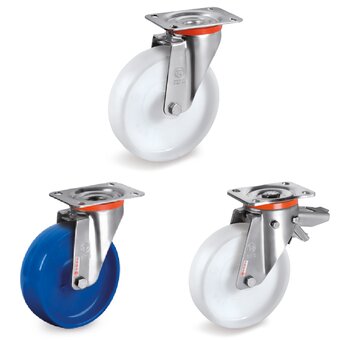
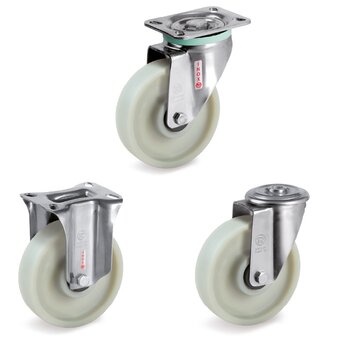
It is a type of industrial wheel that is excellent for trolleys and machinery (carrying medium- and heavy-duty loads), in relation to continuous handling, even in environments with moisture and aggressive chemicals.
They are suitable for mechanical or mixed manual-mechanical handling up to 6 km/h.
Furthermore, they are recommended for all types of floors (also for outdoor use), since they allow easy overcoming of obstacles and do not damage or mark the floors.
For further information: Series 62 NY
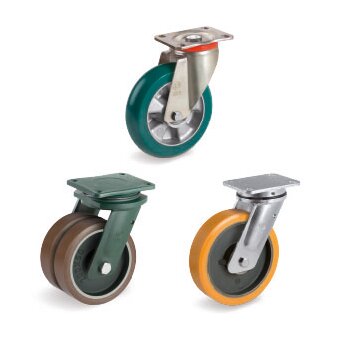
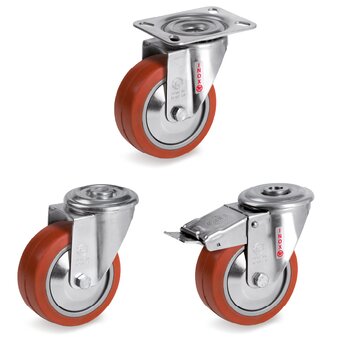
As indicated above, TR-Roll polyurethane wheels offer excellent load capacity and resistance to wear, combined with silent running, as well as shock and vibration absorption.
Combined with suitable castors, such as the aluminium centre, these industrial wheels also guarantee excellent performance for manual or mechanical handling of even heavy-duty loads.
For further information: Series 62 ST
The rounded profile of these wheels reduces the starting resistance for moving the wheels when they are positioned at 90° with respect to the direction of travel, with less operator effort.
Combined with suitable castors, they guarantee excellent performance for mechanical handling up to 16 km/h.
Typical uses: trolleys for the automotive industry, lean trolleys.
For further information: Series 62 ER
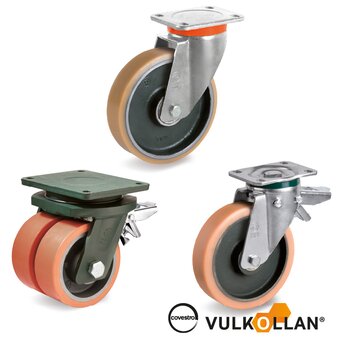
A product offering excellent performance, guaranteed over time, in case of use with mechanically handled heavy-duty loads, at speeds of up to 16 km/h. Excellent vibration damping properties, as well as great rolling resistance, and obstacle roll-over performance.
For further information: Series 62 GH
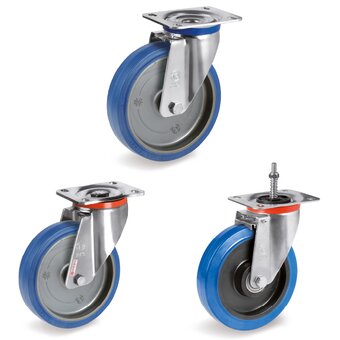
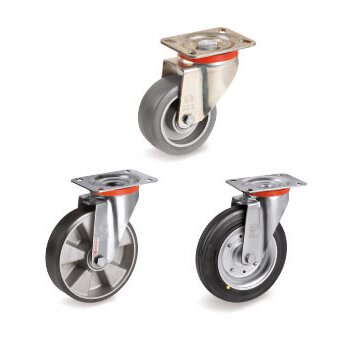
The excellent elasticity of the rubber ensures easy obstacle roll-over, vibration damping and noise reduction.
Combined with suitable castors, these wheels are suitable for mechanical handling up to 6 km/h.
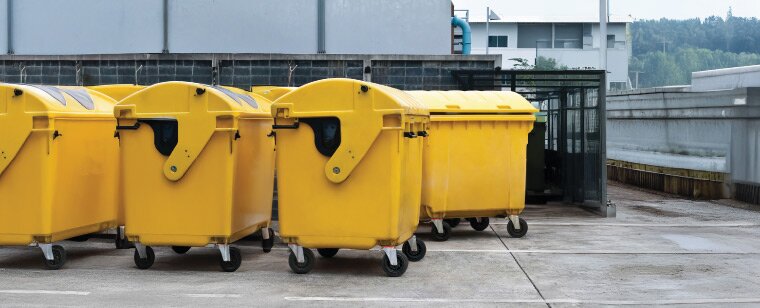
It is recommended to use them for industrial internal and external handling trolleys, manual pallet trucks, and waste bin containers.
For further information: Series 72 AL
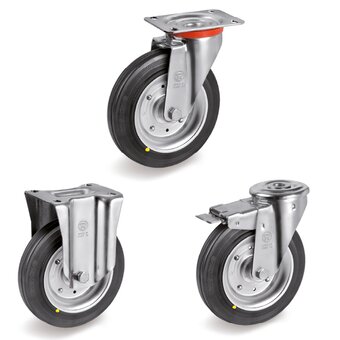
Compared to the previous model, this variant is characterised by the cast iron centre.
These wheels are suitable for all types of flooring, also for outdoor use.
They allow easy obstacle roll-over, do not damage delicate floors, but can mark the flooring.
For further information: Series 72 GH
As we have seen, choosing the most suitable wheels for the various types of surfaces, depends on different factors: from the load, presence of obstacles, but also different types of handling to be performed.