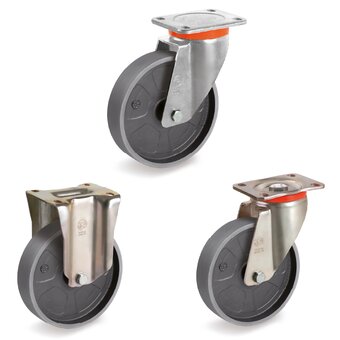
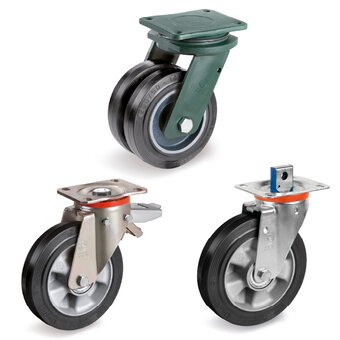
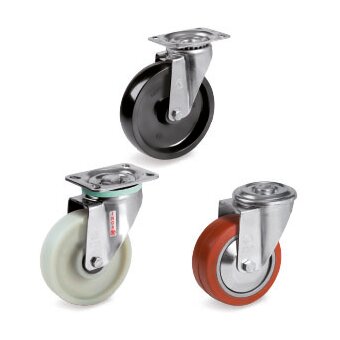
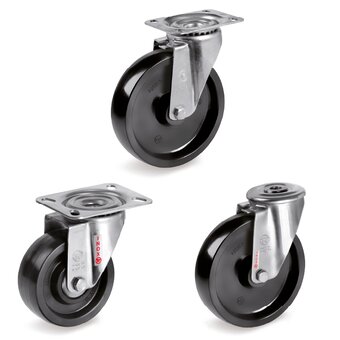
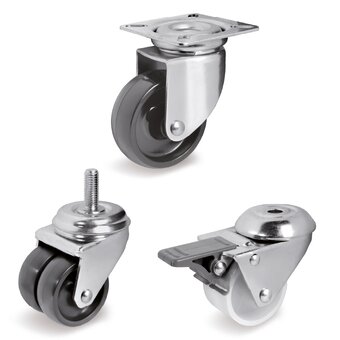
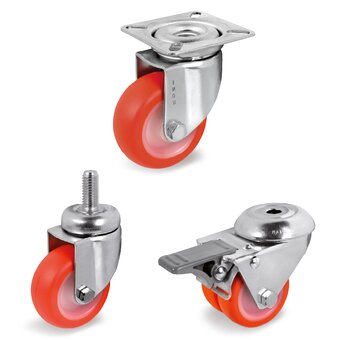
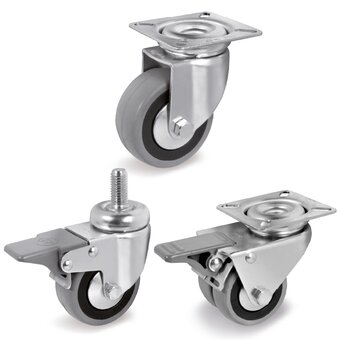
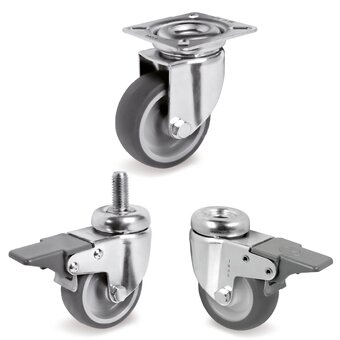
Wheels and castors for food processing industries

'%3e%3cg id='Final-Copy-2_2_' transform='translate(1275.000000, 200.000000)'%3e%3cpath class='st0' d='M7.4,12.8h6.8l3.1-11.6H7.4C4.2,1.2,1.6,3.8,1.6,7S4.2,12.8,7.4,12.8z'/%3e%3c/g%3e%3c/g%3e%3c/g%3e%3cg id='final---dec.11-2020'%3e%3cg id='_x30_208-our-toggle' transform='translate(-1275.000000, -200.000000)'%3e%3cg id='Final-Copy-2' transform='translate(1275.000000, 200.000000)'%3e%3cpath class='st1' d='M22.6,0H7.4c-3.9,0-7,3.1-7,7s3.1,7,7,7h15.2c3.9,0,7-3.1,7-7S26.4,0,22.6,0z M1.6,7c0-3.2,2.6-5.8,5.8-5.8 h9.9l-3.1,11.6H7.4C4.2,12.8,1.6,10.2,1.6,7z'/%3e%3cpath id='x' class='st2' d='M24.6,4c0.2,0.2,0.2,0.6,0,0.8l0,0L22.5,7l2.2,2.2c0.2,0.2,0.2,0.6,0,0.8c-0.2,0.2-0.6,0.2-0.8,0 l0,0l-2.2-2.2L19.5,10c-0.2,0.2-0.6,0.2-0.8,0c-0.2-0.2-0.2-0.6,0-0.8l0,0L20.8,7l-2.2-2.2c-0.2-0.2-0.2-0.6,0-0.8 c0.2-0.2,0.6-0.2,0.8,0l0,0l2.2,2.2L23.8,4C24,3.8,24.4,3.8,24.6,4z'/%3e%3cpath id='y' class='st3' d='M12.7,4.1c0.2,0.2,0.3,0.6,0.1,0.8l0,0L8.6,9.8C8.5,9.9,8.4,10,8.3,10c-0.2,0.1-0.5,0.1-0.7-0.1l0,0 L5.4,7.7c-0.2-0.2-0.2-0.6,0-0.8c0.2-0.2,0.6-0.2,0.8,0l0,0L8,8.6l3.8-4.5C12,3.9,12.4,3.9,12.7,4.1z'/%3e%3c/g%3e%3c/g%3e%3c/g%3e%3c/g%3e%3c/svg%3e) Le tue preferenze relative alla privacy
Le tue preferenze relative alla privacy

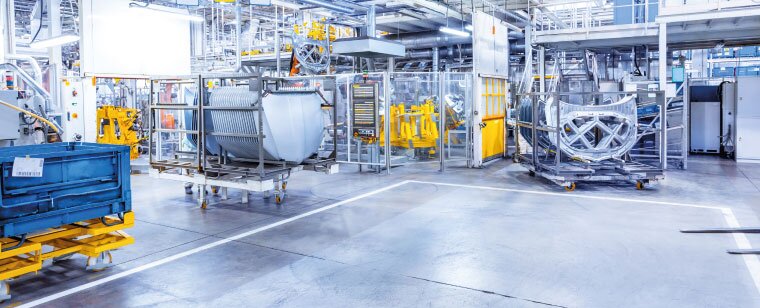
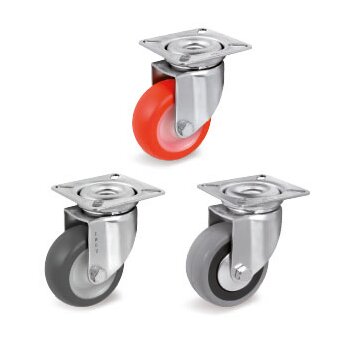
Wheels and castors for food processing industries
Wheels, castors and accessories for trolleys used in internal industrial logistics
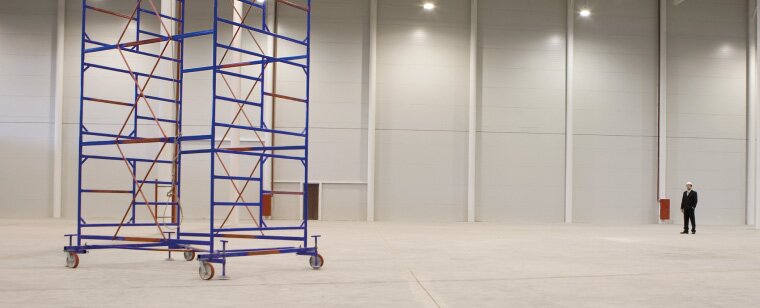
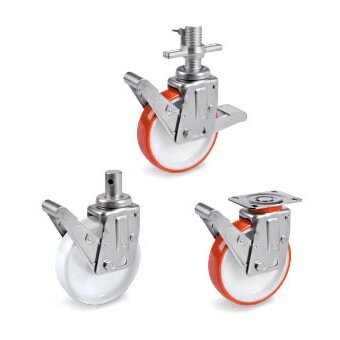
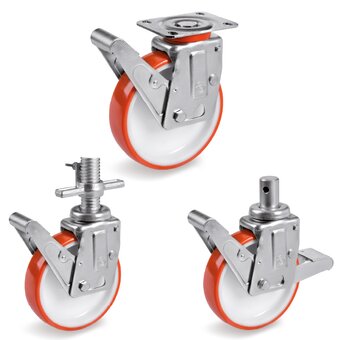
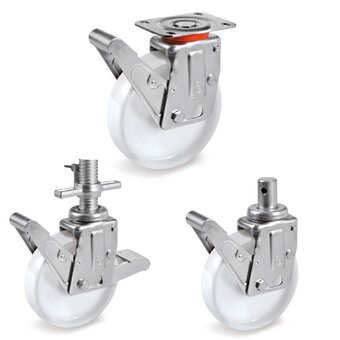
Castors for scaffoldings
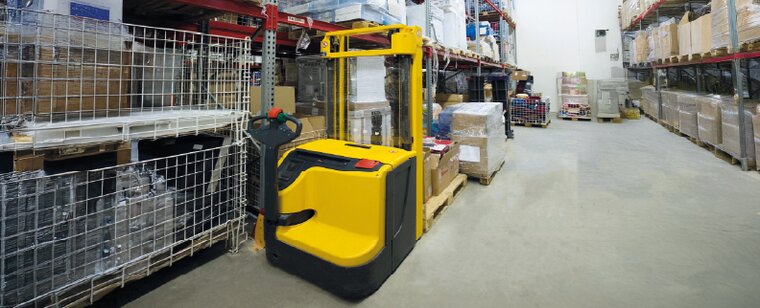
Rollers, drive wheels and stabilizer wheels for pallet trucks
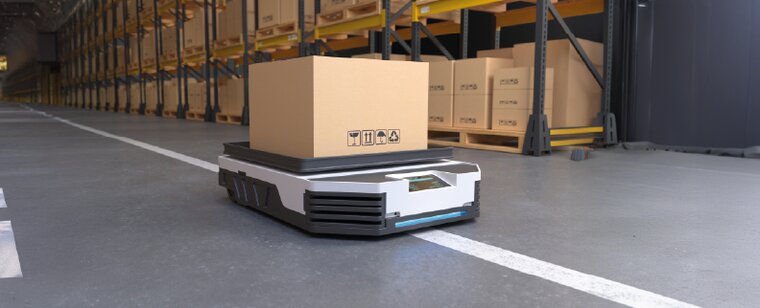
Compact castors and Drive wheels for AGVs, AMRs and robotic systems
 TECHNICAL DATA
The wheel is a circular mechanical assembly that, by means of rotation about an axis, makes it possible to replace sliding motion with rolling motion.
The wheel consists of the following components: tread, covering, centre, bore and rolling actions.
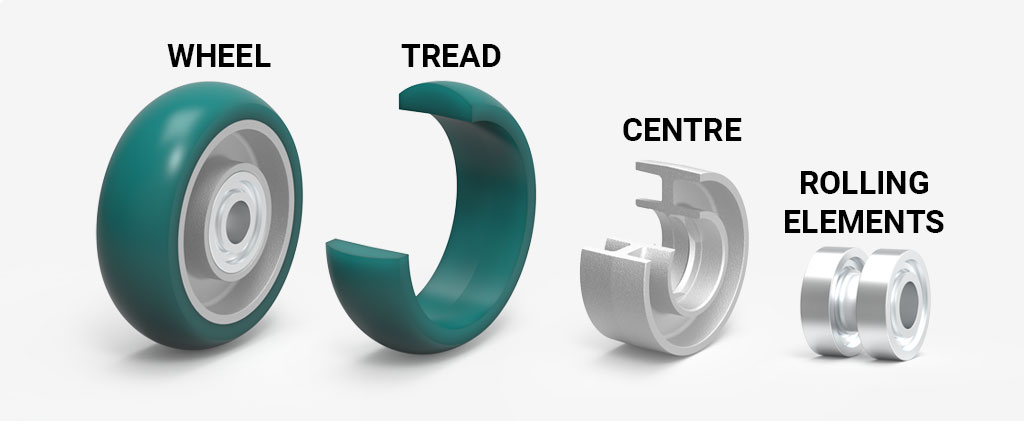
The tread is the wheel's outer surface, i.e. the part in contact with the ground. It can be smooth or sculpted with raised patterns to increase its grip on the ground.
The covering, or rolling strip, is the outer ring, made of different materials and it characterizes the wheel.
The covering is fixed when immovably fixed to the wheel centre (with adhesive or mechanical connection) or fitted when mechanically assembled on the centre.
The centre is the load-bearing component of the wheel that connects the covering to the bore.
The centre is made in various shapes and materials; it can be composed of a single piece or two or more parts joined together.
The bore is the central part of the wheel that houses the axle or the rolling actions designed to facilitate rotation (ball bearings, roller bearings, plain bearings, etc.).
Depending on the construction methods and covering materials, wheels can be divided into four families: rubber wheeels, polyurethane, monolithic (or hard tread) and pneumatic.
The covering of rubber wheels is composed of an elastomer made of natural rubber and/or synthetic rubber.
The rubber used for industrial wheels can be vulcanised or injection moulded.
In the first case, the rubber is mixed with suitable mineral fillers and vulcanising agents and then subjected the vulcanisation process. Vulcanisation changes the molecular structure of the rubber significantly: the soft material at the start of the process is transformed into a non-fusible product that assumes, and retains through time, the shape of the mould in which the reaction occurs. The thus-formed tyre is mechanically assembled to the centre. Vulcanised rubber features enhanced elastic deformability properties within relatively broad ranges of applied tensile and compression loads.
In the second case, the rubber undergoes a chemical synthesis process; the material obtained is then injected into a mould in which the centre has already been inserted. The injected rubber maintains its fusibility properties also after moulding.
The physical-mechanical characteristics of vulcanised rubber vary according to the quality of the natural and/or synthetic rubber used, the type and quantity of mineral fillers added and the conditions under which the vulcanisation process is performed.
Normally, the elastic properties of injection moulded rubber are inferior than those of top quality vulcanised rubber, while they are comparable to those of medium and low-quality vulcanised rubber.
The main physical-mechanical parameters relating to the quality of rubber are listed below (for a definition of each parameter, refer to the technical standard appearing alongside the parameter in question):
| hardness |
UNI EN ISO 868/1999
|
|
specific density
|
ISO 2781 - ISO 1183
|
| resilience |
ASTM D 945 - DIN 53512 - ISO 4662
|
|
abrasion loss
|
DIN 53516
|
|
tensile strength
|
ISO 37 - ASTM D 412c
|
|
elongation at break
|
ISO 37 - ASTM D 412c
|
|
tear strength
|
ASTM D 624b
|
|
compression set
|
ISO 815
|
The above parameters are interdependent, i.e. a change in one parameter normally results in a change in the other parameters (to varying degrees).
The hardness parameter is the most readily measurable: in general, increased hardness is accompanied by a reduction of elastic properties (resilience, elongation at break, compression set) and
a reduction in overall performance of the wheel.
Conversely, parameters such as tear strength and abrasion loss depend mainly on the composition of the vulcanised rubber and, to a lesser extent, on the hardness value.
The covering of polyurethane wheels is composed of an elastomer obtained exclusively from synthetic raw materials.
Polyurethanes are chemical compounds obtained by means of a polymerisation reaction triggered by mixing two components belonging to two different families of compounds (Di-Isocyanates and Polyalcohols), that have been heated to temperatures such as to keep them in the liquid state with relatively low viscosity; elastomeric polyurethanes do not generally contain added mineral fillers. The reactive mixture is cast or injected into heated moulds containing the metal or plastic centres; the temperature of the mould and the centre it contains are such as to guarantee completion of the internal polymerisation reaction of the polyurethane and chemical anchorage of the polyurethane to the adhesive, if present, on the surface of the centre.
The broad range of compatible chemical compounds makes it possible to obtain an infinite number of elastomer formulations; it frequently occurs that the physical-chemical properties of the compound are similar in different stoichiometric formulations ("recipes"), but performance in operation can vary, also significantly, in accordance with the product employed.
Normally, mould-on polyurethane is no longer fusible, has good elasticity characteristics in addition to medium-high hardness and compressive and tensile strength.
Injected polyurethane is fusible even after moulding, and it generally has lower elastic properties but greater hardness with respect to mould-on polyurethane.
The main physical-mechanical parameters of polyurethane are as follows (for a definition of each parameter refer to the technical standard appearing alongside the parameter in question):
| hardness |
UNI EN ISO 868/1999
|
|
specific density
|
ISO 2781 - ISO 1183
|
| resilience |
ASTM D 945 - DIN 53512 - ISO 4662
|
|
abrasion loss
|
DIN 53516
|
|
tensile strength
|
ISO 37 - ASTM D 412c
|
|
elongation at break
|
ISO 37 - ASTM D 412c
|
|
tear strength
|
ASTM D 624b
|
|
compression set
|
DIN 53517
|
In monolithic (hard tread) wheels, the centre and the covering are made of the same material. The wheel's physical-mechanical characteristics vary in accordance with the material used.
Engineering cast iron and thermoplastics are among the materials most frequently used to make this type of wheel.
A pneumatic wheel covering consists of a rubber tyre with fabric insert and inner tube, assembled on the centre. The tread can be sculpted or grooved to increase the grip of the wheel on the ground.